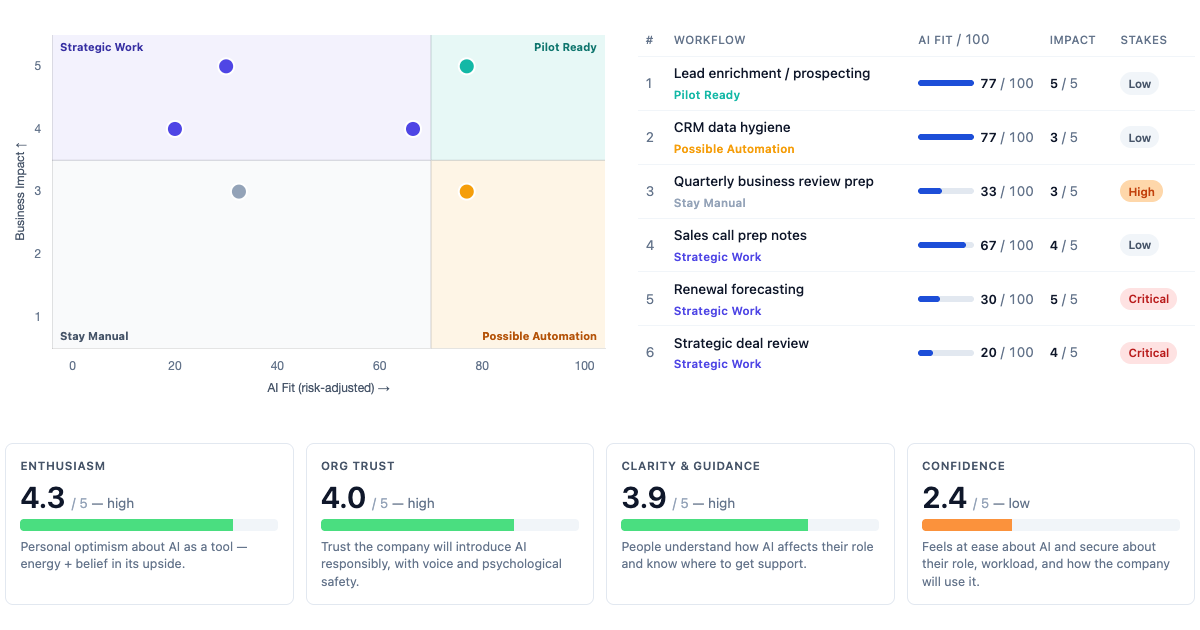
AI Opportunity QuadrantWhere AI fit meets business impact.
Each workflow is placed by how well it suits AI against how much the business depends on it, so leverage is located before anything is automated.
 AdoptionSignal
AI adoption and workforce research prototype
AdoptionSignal was developed to explore where artificial intelligence can create meaningful workforce leverage while preserving the work that depends on human judgment.
The project combines workflow analysis, workforce capability signals, human-judgment mapping, and AI opportunity assessment into a structured diagnostic framework.
Five views that turn workforce evidence into a picture leaders can reason about.
Each workflow is placed by how well it suits AI against how much the business depends on it, so leverage is located before anything is automated.
The decisions, relationships, and accountable calls that depend on human judgment, mapped so they are protected by design rather than by accident.
Enthusiasm, trust, clarity, and confidence, gathered from the people doing the work and reported only as aggregates.
Self-assessed capability across the dimensions that shape adoption: coverage, blind spots, and where growth would matter most.
The workflows where a pilot is most likely to hold up, ordered by the signals above rather than by enthusiasm.
Evidence is gathered from the people doing the work, then combined by explicit rules rather than a black box.
Structured conversations capture how work actually happens: inputs, decisions, hand-offs, and friction.
Each role is decomposed into workflows with observable characteristics rather than job titles.
People rate their own capability and share how they feel about working alongside AI, privately.
Leaders validate the picture against their own knowledge so the evidence is shared, not imposed.
The signals combine into one leadership-ready view: the quadrant, the judgment map, sentiment, and capability.
Project status
AdoptionSignal is not currently offered commercially.
The underlying product, methodology, and related intellectual property are being preserved.
See a sample diagnosis →